Tyler and the East Texas Piney Woods
Foundation repair in Tyler, TX, with the prices written down
Nobody around here posts a price. So this page has the ranges, the permit office and fee for every town, what the Smith County soil survey says about the ground your house sits on, and how to check out a company in a state that does not license them. When you want somebody to come out and look at the house, call the number at the top of the page.
- Price ranges for every repair method, each one sourced
- Permit office, fee and phone number for nine towns
- What the Smith County soil survey says about your lot
Tell us about the house
42.1 in
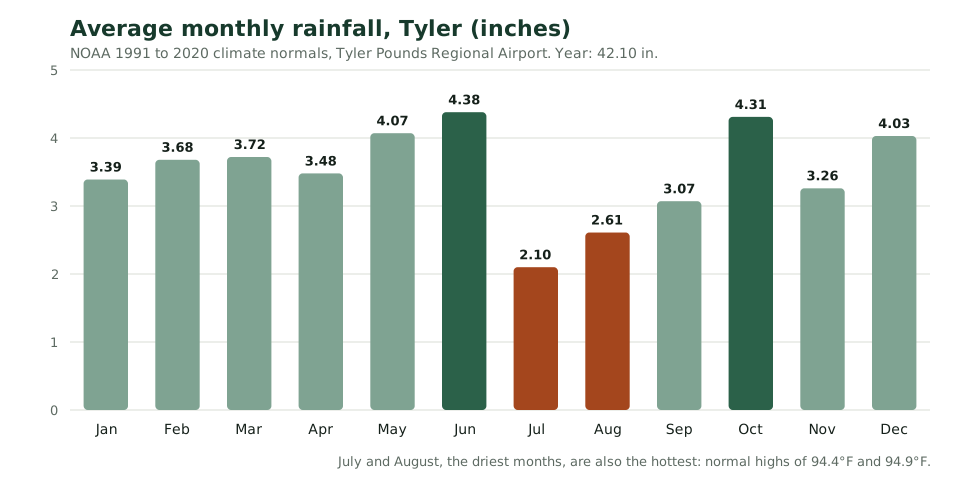
of rain in an average year at Tyler Pounds field, with July the driest month at 2.10 in
0
state licenses required to do foundation repair in Texas. Bills to create one died in 2011 and 2013.
$0.35
per square foot: Tyler's permit fee for residential repairs and alterations
What foundation repair costs around Tyler
Most slab repairs in the Tyler area that need piers run $5,000 to $25,000. What moves that number is how many piers the house needs and which kind. Texas contractors publish $300 to $700 for a pressed concrete pile and $750 to $1,200 for a drilled pier. Pier and beam houses that just need re-shimming often come in at $1,200 to $4,000.
| Job | Typical range |
|---|---|
| Slab repair with piers | $5,000 to $25,000 |
| Pier and beam re-shim or re-level | $1,200 to $4,000 |
| Independent engineer’s evaluation | $300 to $800 |
| Crack injection (seals, does not stop movement) | $250 to $800 per crack |
| Drainage correction | $2,000 to $8,000 |
Those are industry estimates, not Tyler quotes. No foundation company in Tyler publishes its prices and there is no public dataset for East Texas, so the cost guide names the source behind every figure and shows how pier count, method, permits and plumbing tests change the total.
The ground here is not Dallas clay
Almost everything written about Texas foundations is written about the black cracking clay of the Blackland Prairie over around Dallas. The 1993 soil survey of Smith County describes something else. About four acres in five here are sandy or loamy soils sitting on a clay subsoil. Vertisols, the cracking clays that advice is written about, cover about 2.5% of the county, and all of that is down on the Sabine River floodplain.
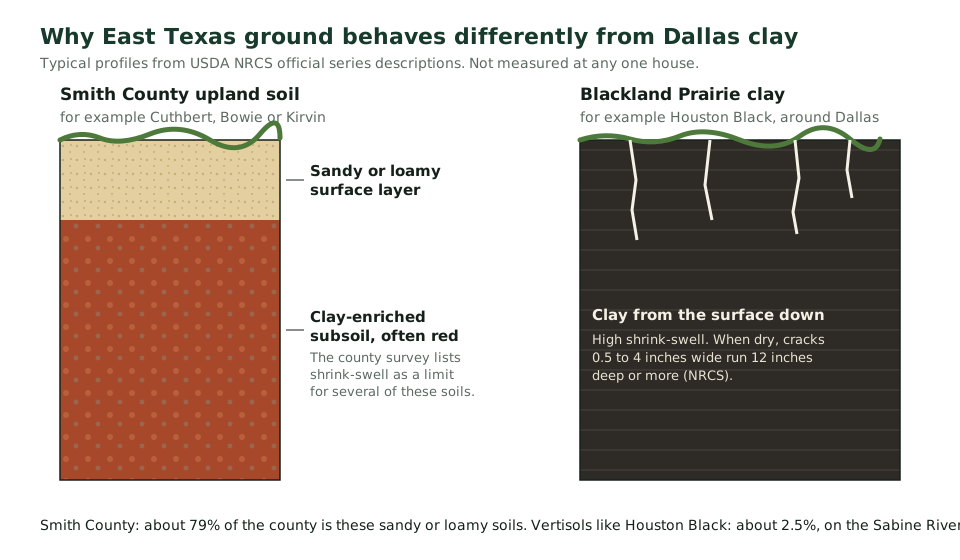
That does not mean the ground is harmless. The same survey lists shrink-swell as a building site limit for several common Smith County soils, Cuthbert among them, and Cuthbert is the most extensive series in the county. Van Zandt County out around Canton is closer to the Dallas picture: about 63% of it sits in soil units whose limits include shrink-swell, mostly rated high. Henderson County splits, sandy on the east side and clay through the west and center. The soil guide goes county by county.

Rain, heat and drought
Tyler averages about 42.1 inches of rain a year. June and October are the wettest months, July the driest. It also averages about 98 days a year at 90°F or hotter. Ground that swings from a wet spring to a dry, hot summer is what moves a foundation.
Anybody who was here in 2011 remembers it. Tyler got 25 inches of rain that year, and exceptional drought covered all of Smith County on eleven straight weekly Drought Monitor maps, August 9 through October 18. The summer of 2022 was a shorter, sharper version of the same thing. If cracks open up during a dry summer, date them, photograph them, and watch whether they keep going. Growth is what an engineer wants to measure.
What each repair actually involves
Each page below explains the work, what it costs, what to ask about, and when a repair is not the right answer.
Permits depend on which side of the city line you are on
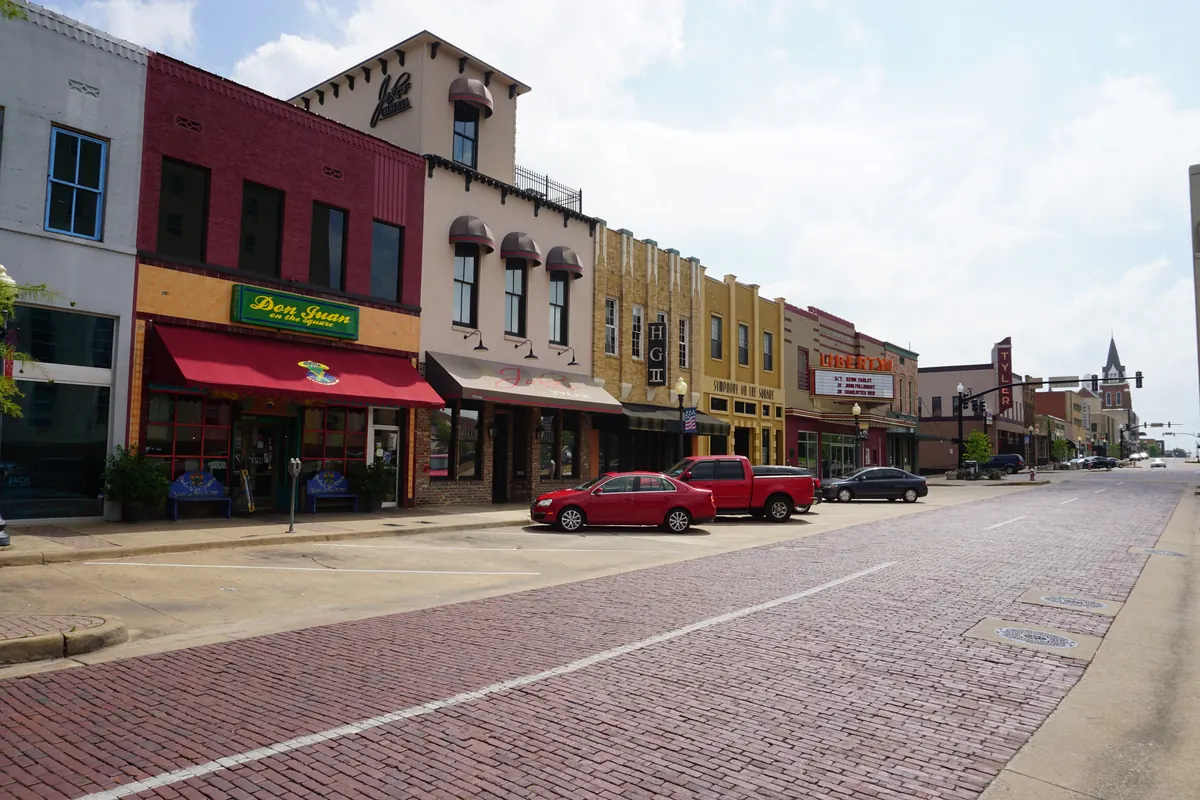
Inside Tyler, residential repairs carry a permit fee of $0.35 per square foot plus a 20% plan check fee, and the city says a permit is required even to replace sheetrock. Canton is the one city around here whose fee schedule names foundation repair outright ($50, with an engineer’s design). Athens wants an engineer’s seal on the foundations its code regulates. Outside the city limits in Smith County there is no building permit.
That last part matters more than people think. No permit means no city inspection, so the contract and the engineer’s report are the only paper trail you will ever have. The permit guide lists every office, phone number and fee.
Towns covered
Smaller towns like Hideaway, Troup, Noonday, Arp, Winona, Rusk, Van and Gun Barrel City are on the service areas page.
Before you hire anyone
Check the company yourself
Texas does not license foundation repair companies. Bills to create a license passed the Senate in 2011 and died in the House, and a second attempt in 2013 also failed (SB 1399, HB 613). So the checks that matter are yours to make. Each takes a few minutes.
- Ask who the engineer is. The Texas engineering board says working out why a foundation moved, or recommending how to repair it, is the practice of engineering (Advisory Opinion 43). Get the engineer's name and look up the license on the state roster.
- Check the plumber's license. If the job includes a plumbing test or a leak repair, the plumbing has to be done under a licensed plumber. Look the license up with the Texas State Board of Plumbing Examiners.
- Read the warranty before you sign. Get it in writing, see whether it transfers when you sell, and find the clauses that void it. Watering and plumbing conditions are the ones homeowners most often learn about too late.
- Ask who pulls the permit. Most cities here charge a permit fee for repairs, and Canton names foundation repair in its fee schedule. Unincorporated county land has no building permit at all. Our permit guide lists each office.
- Keep the paperwork. If a job goes wrong, Texas law makes you give the company written notice at least 60 days before you sue under the Deceptive Trade Practices Act (Bus. & Com. Code §17.505). Estimates, contracts, photos and emails are your record.
Guides
What happens after you call or send the form
- 1
It goes to one company
One independent foundation repair company that works your area. Not a list of nine, not an auction, and your number is not sold on.
- 2
They call to set up a visit
Most foundation companies around Tyler advertise a free inspection or estimate. Ask on that first call anyway, so nobody is surprised later.
- 3
You get it in writing
The estimate should name the repair method, how many piers and where, who designs the repair, the permit, the warranty and the price. Hold it up against the published price ranges.
- 4
You decide
No obligation either way. If you want a second opinion, an independent structural engineer's evaluation usually runs $300 to $800.
Questions people ask first
Should I call a home inspector, a structural engineer, or a foundation repair company to see if I need foundation repair?
Depends what you want out of it. A foundation company’s inspection is usually free, but that same company sells the repair. A home inspector reports what he can see and does not have to find the cause. A structural engineer’s evaluation, usually $300 to $800, tells you why the house moved and what repair it needs, and Texas’s engineering board treats that diagnosis as engineering work. More on that in engineer or foundation company.
I think my foundation has shifted. Should I be worried?
Watch for the things Texas home inspectors are told to write up: doors that bind or will not latch, gaps at trim and frieze boards, floors that slope, cracks in walls, ceilings or brick. No single one of those proves anything. Several together, or a crack that keeps growing, is worth an evaluation. The signs guide covers what engineers actually measure.
How much does foundation repair cost in Tyler?
Most slab repairs that need piers land between $5,000 and $25,000. Pier and beam houses that only need re-shimming usually run $1,200 to $4,000. Those are industry estimates, because no Tyler company publishes prices. The cost guide breaks it out by method, pier count, engineer, permit, plumbing and drainage, and names the source for every number.
Do I need a permit for foundation repair in Tyler?
Inside the city limits, plan on it. Tyler’s fee schedule charges $0.35 per square foot for residential repairs and alterations, and the city says you need a permit even to replace sheetrock, though it has never published a rule written specifically for foundation work. Canton names foundation repair right in its fee schedule. Out in unincorporated Smith County there is no building permit at all. Town by town in the permit guide.
Is the free inspection really free?
Usually, and it is worth asking on the first call anyway. Most companies working Tyler and the surrounding towns advertise a free inspection or estimate for a homeowner. What is not free is an independent structural engineer’s evaluation, $300 to $800, which is the one that is not tied to selling you the repair. If a house is changing hands or the numbers are big, that is money well spent.
Sources
Each source was opened and checked on the date shown.
- Climate normals 1991 to 2020, Tyler Pounds Regional Airport (USW00013972), NOAA National Centers for Environmental Information. Checked September 21, 2026.
- Drought severity statistics, Smith County, 2011, U.S. Drought Monitor. Checked September 21, 2026.
- Global Summary of the Year, Tyler Pounds, 2010 to 2023, NOAA National Centers for Environmental Information. Checked September 21, 2026.
- SB 1399, 82nd Legislature: bill history, Texas Legislative Reference Library. Checked September 21, 2026.
- Year structure built (B25034), places in Smith County, ACS 2020-2024, U.S. Census Bureau. Checked September 21, 2026.
- Soil Survey of Smith County, Texas (1993), USDA Soil Conservation Service. Checked September 21, 2026.
- Soil Survey of Van Zandt County, Texas (1998), USDA Natural Resources Conservation Service. Checked September 21, 2026.
- Official series description: Houston Black, USDA NRCS. Checked September 21, 2026.
- Schedule of Fees, City of Tyler. Checked September 21, 2026.
- Engineering Advisory Opinion Request #43, Texas Board of Professional Engineers and Land Surveyors. Checked September 21, 2026.
- Standards of Practice, 22 TAC §535.228 (foundations), Texas Real Estate Commission. Checked September 21, 2026.
- foundation repair question, TexAgs forum. Checked September 21, 2026.
Next step
Get a written estimate from a local foundation company
Tell us what you are seeing and where the house is. Then ask the questions on this page before anyone lifts a shovel.