Foundation repair methods compared: pier types, costs and why bids differ
What the four common pier types are, what each costs, and the line items that can put two bids for the same house thousands of dollars apart.
Checked September 21, 2026 · 20 sources · 10 min read
Ask several foundation companies to look at one house and you can get very different answers. A West Houston homeowner who had four or five repair companies out wrote that their assessments “all differ quite a bit.” This guide sets out what each pier type is, what the published prices say, and which line items make bids differ.
What are the pros and cons of each type of pier?
We found no independent source that ranks pressed concrete, drilled concrete, steel push and helical piers against each other. What the sources do give is how each type goes in and what it costs, mostly from Texas contractors and national cost guides. Which one fits your house is a call for the engineer who designs the repair.
The ASCE Texas Section guidelines say, “The evaluation and repair design shall be performed by a professional engineer licensed in the State of Texas.” They are guidelines, not law. But the Texas engineering board also says that recommending a foundation repair is engineering. So ask each company who designed the plan in its bid.
Method
What it is
Price per pier (industry estimate)
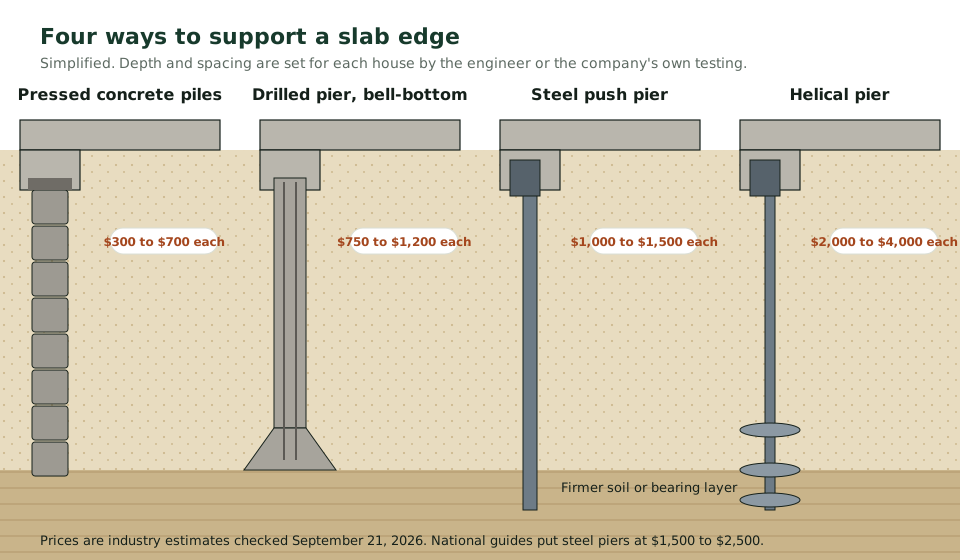
Pressed concrete piles
Short concrete cylinders, stacked and pressed into the ground
$300 to $700 per pile (Texas contractors)
Drilled concrete piers
A drilled hole filled with concrete; a bell-bottom pier widens at the base
$750 to $1,200
Steel push piers
Steel pipe pushed down to firm soil
$1,000 to $1,500 (Texas contractors); $1,500 to $2,500 (national guides)
Helical piers
A steel shaft with screw-shaped plates
$2,000 to $4,000
Common underpinning methods under a slab. Depths vary by site; an engineer or the company's own testing sets them.
Pressed concrete piles
Pressed piles are short concrete cylinders, stacked one on another and pressed into the ground under the slab. Texas contractors price them at $300 to $700 per pile, installed. National cost guides do not price this method. The figures come from Texas contractors, mainly Stratum near Dallas and Anchor in Bryan.
Anchor sets perimeter piles about every 7 feet and puts its average pressed-pile job at about $11,000.
Drilled concrete piers, straight or bell-bottom
A drilled pier starts as a hole drilled in the ground and filled with concrete. A bell-bottom pier is wider at the base, like a bell. Texas contractors price them at $750 to $1,200 per pier.
Anchor’s own price list charges more for a pier inside the house than for one outside. It also lists “mud-pumping,” which fills the gaps under the slab after a lift, as a separate charge.
Steel push piers
A steel push pier is steel pipe pushed down to firm soil under the slab. Texas contractors price them at $1,000 to $1,500 per pier. National cost guides say $1,500 to $2,500. National guides in general quote higher per-pier prices than Texas contractors, and they often do not say which method they mean.
Helical piers
A helical pier is a steel shaft with screw-shaped plates. The published range is $2,000 to $4,000 per pier. It is drawn mainly from national cost guides such as HomeGuide and Today’s Homeowner, plus Olshan Foundation Repair’s 2026 price list.
Mudjacking, foam and crack injection
These are not piers, but they can appear on the same bid. Mudjacking and polyurethane foam lifting are sold by the square foot. Texas contractor sources describe using both mainly to fill gaps under a slab after a pier lift, not as the repair itself.
Crack injection seals a crack but does not stop movement. Prices for all three are in the Tyler cost guide.
What about pier and beam houses?
A raised house gets different work: re-shimming, new piers, and beam or sill replacement. Our guide to slab vs pier and beam covers both types, and the house leveling page covers the raised-floor work.
What does a whole pier job cost?
Industry estimates put a slab pier job at $5,000 to $25,000, from one corner to the whole perimeter. The averages contractors publish fall inside that range. Stratum’s is about $5,300 around Dallas-Fort Worth, Anchor’s about $11,000 for pressed piles, and Olshan’s $11,950 nationwide. No Tyler company publishes its prices.
Industry estimates compiled from the sources named in each row, checked September 21, 2026. These are not Tyler prices. No Tyler foundation company publishes its prices, and no government or university dataset of foundation repair costs exists for Tyler or East Texas.
The count matters as much as the price per pier. Texas contractors describe 4 to 10 piers for a corner or one wall, and 12 to 25 or more for a full side or the whole perimeter. They space them about 7 feet apart.
A cheaper pier does not always mean a cheaper bid. Twenty pressed piles at $500 each come to $10,000. Eight drilled piers at $1,200 each come to $9,600.
No public dataset of repair costs exists for Tyler or East Texas. Treat every figure here as an industry estimate.
Why are bids for the same house so different?
Two bids can describe two different jobs. One Dallas-Fort Worth home buyer on Houzz had one bid for 37 piers at $21,000 and another for 13 piers at $5,900. Before you compare the totals, compare what each bid includes, line by line. Here is what to check.
Pier count and spacing
Start with the count, because it multiplies the price per pier. Ask each company for a drawing that shows where every pier goes and how far apart they are. A bid for one corner and a bid for the whole perimeter are different jobs.
Pier depth
The sources we used publish no standard depth for any pier type. The drawing above notes that depths vary by site, and that an engineer or the company’s own testing sets them. Ask each bid to state how deep the piers will go, or how the depth will be decided.
Piers inside the house
Most piers go around the edge, but some jobs need interior piers too. Anchor’s price list charges more for a pier inside the house than for one outside. If one bid has interior piers and another does not, ask why.
The engineer
Some bids include an engineer’s evaluation and a letter after the repair, and some do not. One Texas engineering firm’s estimating template lists the engineering inspection as its own line. A structural engineer’s evaluation typically costs $300 to $800. A letter after the repair runs $200 to $500, based on one published source.
Permit rules and fees change from town to town. Tyler charges $0.35 per square foot for “All Additions, Alterations, Repairs,” plus a plan check fee of 20% of the permit fee. It publishes no rule written for foundation repair. Canton’s fee schedule lists “Foundation Repairs $50.00 with Engineer Design.”
Outside city limits, Smith County has no building permit. It says it has “no local building policies for construction in unincorporated areas of the county,” other than subdivision rules. Flood zones there still need a county floodplain permit.
In Tyler, have the company pull the permit or confirm with Building Services at (903) 531-1151. Our permit guide lists every office.
Plumbing tests
Some bids include a plumbing test before and after the lift, and some leave it out. A hydrostatic, or static, test checks the pipes under the slab for leaks. Published Texas figures put it at $100 to $800.
Warranty terms can require one. A League City buyer was told that reinstating a transferred warranty required “a hydrostatic test performed to check for under slab leaks.” A North Texas engineering firm writes that plumbing repairs after foundation work “can equal or even exceed the cost of the foundation work itself.” Ask who pays if a test after the lift finds a leak, and see our slab leak repair page.
Drainage
Some companies add drainage work to the bid, and a drainage correction package runs $2,000 to $8,000. The ASCE Texas guidelines say downspouts “should be extended well past the edge of the foundation.” They also call for the ground to drop at least 6 inches in the first 10 feet away from the house. Our drainage correction page explains the options.
The warranty
Warranties differ in length, in what voids them, and in whether they transfer when you sell. Texas homeowners have reported warranty claims turned down over three things: not watering, soaker hoses that were not installed, and a transfer not made within 30 days. Our warranty guide covers the clauses to look for.
What should a written bid include?
Ask every company for the same things in writing, so the bids line up. A complete bid names the method, the number and location of piers, who designs the repair, the permit, any plumbing tests and the warranty terms. If a bid leaves one out, ask about it before you compare prices.
The method, and a drawing of where each pier goes
How deep the piers will go, or how depth will be decided
Any interior piers, and whether filling gaps under the slab is included
The engineer’s name and license number, and whether you get a letter after the repair
Who pulls the permit, and whether the fee is in the price
Plumbing tests before and after, and who pays for any leak repair
Any drainage work
The warranty: how long it lasts, what voids it, and how it transfers
Before you hire anyone
Check the company yourself
Texas does not license foundation repair companies. Bills to create a license passed the Senate in 2011 and died in the House, and a second attempt in 2013 also failed (SB 1399, HB 613). So the checks that matter are yours to make. Each takes a few minutes.
Ask who the engineer is. The Texas engineering board says working out why a foundation moved, or recommending how to repair it, is the practice of engineering (Advisory Opinion 43). Get the engineer's name and look up the license on the state roster.
Check the plumber's license. If the job includes a plumbing test or a leak repair, the plumbing has to be done under a licensed plumber. Look the license up with the Texas State Board of Plumbing Examiners.
Read the warranty before you sign. Get it in writing, see whether it transfers when you sell, and find the clauses that void it. Watering and plumbing conditions are the ones homeowners most often learn about too late.
Ask who pulls the permit. Most cities here charge a permit fee for repairs, and Canton names foundation repair in its fee schedule. Unincorporated county land has no building permit at all. Our permit guide lists each office.
Keep the paperwork. If a job goes wrong, Texas law makes you give the company written notice at least 60 days before you sue under the Deceptive Trade Practices Act (Bus. & Com. Code §17.505). Estimates, contracts, photos and emails are your record.
We pass it to one independent foundation repair company that works in your area. Not a list, and not an auction.
2
They call to set up a visit
Most Tyler-area foundation companies advertise a free inspection or estimate. Ask on that first call, so there are no surprises.
3
You get a written estimate
It should name the repair method, how many piers and where, who designs the repair, the permit, the warranty and the price. Compare it with our published price ranges.
4
You decide
There is no obligation. If you want a second opinion, an independent structural engineer's evaluation usually costs $300 to $800.
Pier and bid questions
My question is what are pros and cons of each type of pier.
No independent source we found ranks one type above the others. The clear differences are in price: Texas contractors quote $300 to $700 for a pressed concrete pile, $750 to $1,200 for a drilled concrete pier and $1,000 to $1,500 for a steel push pier. Helical piers run $2,000 to $4,000. Which type suits your soil and your house is a design call for a Texas-licensed engineer.
How deep do drilled piers go, and is that a concern?
The sources we used publish no standard depth for any pier type, and depths vary by site. An engineer or the company’s own testing sets them. Ask each company to write in the bid how deep its piers will go, or how the depth will be decided. Then ask the engineer whether that suits the soil under your house.
What keeps the pier from moving when the soil expands/contracts with more/less moisture?
That is the right question to put to the engineer, because the answer depends on the pier design and the soil under your house. We found no independent source that answers it for one method over another. Ask how deep the piers will go, what they will rest on, and what the warranty covers if the house moves again.
Curious if y'all had any thoughts on the drastic difference in bids?
Line the bids up item by item before you look at the totals. The Dallas-Fort Worth buyer who asked this had bids of 37 piers for $21,000 and 13 piers for $5,900, so the two companies were proposing different jobs. Compare pier count and placement, interior piers, the engineer, the permit, plumbing tests, drainage and the warranty. Then ask each company to explain the gap.
When you say price per pier, what do you mean by the pier?
One support set under the foundation, installed. A per-pier price may not cover the whole job. One Texas engineering firm’s estimating template lists the permit, the engineering inspection, the lift and a plumbing test as separate lines. Ask for the price per pier, the number of piers and the total, all in writing.
Sources
Each source was opened and checked on the date shown. If a link has moved, tell us and we will fix it.
Get a written estimate from a local foundation company
Tell us what you are seeing and where the house is. Your request goes to one independent foundation repair company that works in your part of East Texas. Ask them the questions on this page before anyone lifts a shovel.