Texas homeowners ask two warranty questions again and again: “Are foundation warranties automatically transferred to a new owner of a home that had previous foundation work done?” and “What to do if company won’t honor warranty?” Warranty questions came up in about 11 separate threads we read, most from Texas homeowners on Justia’s Ask a Lawyer site. None of the 13 foundation repair and cost-guide web pages with question headings that we read asked either one.
Are foundation warranties automatically transferred to a new owner?
Only if the warranty’s own terms say so, and each company writes its own. Of the Texas cases we read, one lifetime warranty “transfers to new owners at no charge.” Another needed a fee and a plumbing test before the company would reinstate it. A third was called void because nobody transferred it within 30 days.
No state agency sets these terms. Texas does not license foundation repair companies. SB 1399 passed the Senate in 2011 and died without a House floor vote. HB 613 reached the House calendar in 2013 and did not become law.
The House committee’s analysis of SB 1399 put the concern this way: “Interested parties assert that increasing numbers of predatory practices by foundation repair companies have been reported. They argue that currently there is no state regulation in place to directly mitigate these risks.”
The second case is from League City (Justia, December 2024). There, reinstating the previous owner’s warranty took “a hydrostatic test performed to check for under slab leaks,” “a $250 transfer fee” and a “$75+ inflation fee.” The third is from Houston (Justia, September 2022). So read the transfer section for:
- Whether the warranty transfers at all, and how many times
- Who has to act: the seller, the buyer, or both
- The deadline, and when it starts (the Houston warranty had a 30-day window from the purchase)
- The fee, and whether it can go up (the League City company added an “inflation fee”)
- Any test or inspection needed first
- Whether the new owner gets the same coverage as the first owner
- What written proof you get that the transfer went through
Buying a house that has had work done? See buying a house with foundation repair.
What does a “lifetime transferable warranty” really cover?
Only what the document spells out. A warranty called “lifetime” or “transferable” can still set limits: what the lifetime is tied to, which part of the house is covered, what the company does on a claim, what it charges, and what voids it. Read those details before you sign, and keep a copy.
A Baytown homeowner asked Justia in December 2023: “What can I do if I paid for a lifetime transferable warranty with a foundation company and they will not honor it.” The answer starts with the paper. Use these questions to read yours.
| Clause | Questions to ask |
|---|---|
| Length | “Lifetime” of what? Does it end when the house is sold, or when a transfer deadline passes? |
| What is covered | Only the piers that were installed? Only the side of the house that was repaired? Or the whole foundation? |
| What the company does on a claim | Adjust the existing piers? Add piers? Free, or for a fee? |
| Damage from the work | Does it cover cracks, broken tile or sticking doors caused by the lift itself? |
| Watering and drainage | Does it require watering, soaker hoses, gutters or grading? What proof will the company accept? |
| Plumbing | Does a leak void it? Is a plumbing test required before the work, after it, or at transfer? |
| Trees and additions | Does it exclude movement blamed on trees, an addition or a remodel? |
| Transfer | Is there a deadline, a fee, a test or a form? |
| Claims | How do you file? How fast must the company answer? Can you get a second opinion? |
| If the company closes | Who honors the warranty if the company closes or is sold? |
How long do these warranties last? The TexAgs question “how long is foundation typically under warranty for?” has no single answer, and we found no published standard. The Texas cases we read included a 10-year warranty and lifetime warranties. Some work comes with none: a Houston Heights owner was told there was “no warranty as it would just move again” on pier and beam work.
Why do foundation companies deny warranty claims?
In the Texas warranty questions we read, companies pointed to four things: not watering, no soaker hoses, drought, and a transfer done too late. In another case the company and three other companies disagreed about what needed fixing. Find the conditions in your warranty before you sign, and keep proof you met them.
Here is what happened in those cases:
- Little Elm, December 2023. A few months after the work, the company blamed “the summer drought and not watering,” said the house needed “10 more piers,” and would not honor the warranty.
- Houston, September 2022. The company said a 10-year warranty was void because it “was not transferred within 30 days of purchase” and “Soaker hoses weren’t installed.”
- San Antonio, February 2025. The company refused its warranty and proposed a $10,000 lift. Three other companies said that lift was not needed.
- Baytown, December 2023. A homeowner who “paid for a lifetime transferable warranty” asked what to do when the company would not honor it.
Watering comes up often. About 8 separate threads we read ask whether you really have to water a foundation, such as the City-Data title “To prevent foundation damage you need to water foundation? Use soaker hose?”
The engineering guidance is careful. The ASCE Texas Section repair guidelines say “maintaining near uniform soil moisture conditions near all sides of the foundation may be beneficial.” They also say: “Caution should be advised against excessive watering.”
If your warranty requires watering, get the method in writing: where, how often, and what counts as proof. The Little Elm refusal followed a summer drought, and Tyler has dry stretches too. July averages 2.10 inches of rain at Tyler, the least of any month, and August is the hottest month (NOAA normals).
What upkeep will the warranty expect?
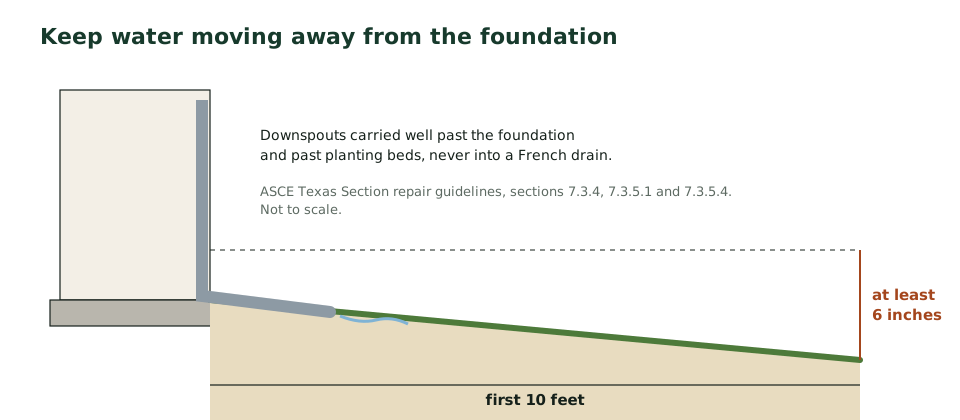
Read the maintenance clause before you sign, then do what it says and keep dated proof. The ASCE Texas Section repair guidelines give the engineering view of that upkeep: ground that slopes away from the house, downspouts that drain well past it, care with trees, and even soil moisture without overwatering.
The guidelines put it this way:
- Slope: “a minimum slope of 5 percent (i.e. 6 inches in 10 feet) away from the foundation should be provided for the first 10 feet all around” (section 7.3.5.1).
- Downspouts: “Downspouts should be extended well past the edge of the foundation, past the edge of abutting planting beds, and into well-drained areas” (7.3.4).
- Drains: “Downspouts and surface drains should not be connected to perforated pipe subsurface drainage systems” (7.3.5.4).
- Trees: “Trees or large shrubs near a foundation may cause soil shrinkage under the foundation” (7.3.2).
Keep dated photos of gutters, downspouts and any soaker hoses, and receipts for drainage work. If the warranty requires watering, keep a simple log. If the house needs drainage work first, see drainage correction and the cost guide.
What should the warranty say about plumbing leaks?
Look for two things: any clause that voids coverage after a plumbing leak, and any plumbing test the company requires before the work, after it, or at transfer. Published Texas figures put a hydrostatic (static) test at $100 to $800. Get the results in writing and keep them with the warranty.
| Work | Typical price | Where the figure comes from |
|---|---|---|
| Hydrostatic (static) plumbing test | $100 to $800 | Published Texas figures: Stratum $100 to $300, Anchor about $300, Two Brothers $350 to $600, A-1 Engineering $800 |
| Leak detection visit | $100 to $400 | Fixr, HomeGuide |
| Tunneling under the slab for one repair | $900 to $2,000 | Fixr (the only published figure we found) |
| Rerouting one line | About $700 | HomeGuide |
| Rerouting or repiping larger sections | $3,900 to $15,000 | HomeGuide, Fixr |