House leveling and pier and beam repair in Tyler, TX
What leveling a pier and beam house involves, from new shims to new sills, what each step costs, and what an inspector can and cannot see from the crawl space door.
Checked September 21, 2026 · 20 sources · 8 min read
On this page, house leveling means bringing the floor of a pier and beam house back toward level by working in the crawl space under it. It can be a quick re-shim or a bigger job with new piers, beams or sills. Here is what each involves, what it costs, and what to check before anyone crawls under your house.
Is your house pier and beam?
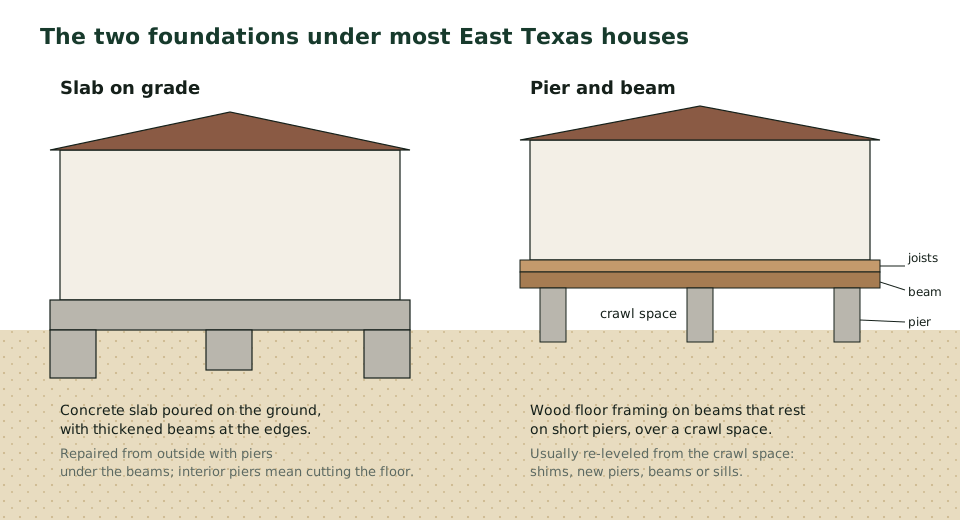
If the floor sits above a crawl space, on wood framing that rests on beams and short piers, it is pier and beam. A slab house sits on concrete poured on the ground. The difference matters because a pier and beam floor is adjusted from underneath, in the crawl space, instead of by lifting a slab.
The two foundation types you will find under most East Texas houses.
What does a pier and beam problem look like from inside?
Usually it shows in the floors and doors. When Texas home inspectors judge a foundation, the signs they must report include “binding, out-of-square, non-latching doors,” “sloping floors,” and cracks in walls, ceilings and floors. None of these proves the cause, but each is worth writing down with a date.
One East Texas owner described a 1968 brick pier and beam house in “sandy east Texas soil” with “lots of humps in the floor” and doors that would not close. Sandy soil did not keep that house level. Our guide to the signs of foundation problems covers the other warning signs.
Older houses in Tyler and nearby towns
Tyler has a lot of older housing. Census estimates say 52.6% of the city’s homes were built before 1980. The city’s own comprehensive plan says most of the older housing is downtown in the Azalea Historic District, in Midtown and in the northern part of the city.
Athens (54.0%), Canton (54.7%) and Jacksonville (50.3%) also have more than half their homes built before 1980. We found no count of how many of these houses are pier and beam, so we do not guess at one.
If yours is older, find out whether it has been leveled before. Records of past work help whoever looks at it next. The Tyler page has more on the city’s housing.
What leveling can involve, from shims to sills
Leveling runs from small to large. A re-shim adjusts the supports you already have so the floor sits flatter. Bigger jobs add or replace piers, replace damaged beams, or replace sills, the wood that runs along the bottom of the walls. The price climbs with each step and with how much wood has to come out.
Re-shim or re-level. Industry estimates put it at $1,200 to $4,000.
New piers or pads. These usually come as part of the bigger jobs, which run $5,000 to $15,000. We found no clear published price for a single new pier block or pad. One national guide’s figure does not say whether it is per pier or per job.
Beam and sill replacement. Sill plates run $100 to $200 per linear foot. Published prices for replacing a beam disagree too widely to quote one range.
Getting under the house. One Texas engineering firm says pier and beam repair costs depend on “crawlspace access and the extent of wood replacement.”
The permit. Tyler’s fee schedule charges $0.35 per square foot for “All Additions, Alterations, Repairs,” but the city publishes no rule written for foundation work. Ask the company whether it will pull one, or call Building Services at (903) 531-1151.
What whole jobs cost
Job
Typical total
Where the figure comes from
Slab repair with piers (a corner to the whole perimeter)
$5,000 to $25,000
Contractor averages: Stratum about $5,300 (DFW), Anchor about $11,000 for pressed piles, Olshan $11,950 (national, 2026); HomeGuide and Angi put underpinning at $10,000 to $30,000
Industry estimates compiled from the sources named in each row, checked September 21, 2026. These are not Tyler prices. No Tyler foundation company publishes its prices, and no government or university dataset of foundation repair costs exists for Tyler or East Texas.
Treat these as a yardstick for written bids, not a quote. Our cost guide has every range with its source.
What is going on in your crawl space?
The crawl space is where the piers, beams and sills can be seen, and a Texas home inspection is supposed to look there. The state’s standards make the inspector report deteriorated materials; problems with beams, joists, piers, posts, sills or subfloor; and crawl space ventilation or drainage “that is not performing.”
There is a catch. The inspector does not have to enter a crawl space with less than 18 inches of headroom, or one whose access opening is smaller than 24 inches wide and 18 inches high. The report must say where the crawl space was inspected from. If that was the access opening, no one has looked at the far corners up close.
Wood rot is also a question on the Texas seller’s disclosure form. It asks whether the seller knows of “Termite or Wood Rot Damage Needing Repair” or any “Previous Structural or Roof Repair.” If you are buying, ask for the leveling records, and read our guide to buying a house with foundation repair. Water around the house matters here too; see drainage correction.
Will the house need leveling again?
It might, so get the company’s answer in writing. One Texas contractor that publishes pier and beam prices lists a separate price for return visits by past customers. A Houston homeowner was told there would be “no warranty as it would just move again.” Ask what the warranty covers if the floor moves, and for how long.
If the floor keeps moving, ask why. Texas’s engineering board treats finding the cause of foundation movement as engineering, so the answer should come from a licensed engineer. Our page on foundation inspections explains what an engineer’s visit covers.
Leveling a manufactured or mobile home
We did not find a published source on leveling manufactured or mobile homes, so this page gives no methods or prices for them. If your home is manufactured, say so on the first call and ask whether the company does that kind of leveling at all.
Then ask the same questions you would for any house: who decides what gets done, what it costs in writing, and what the warranty covers.
Before you hire anyone
Check the company yourself
Texas does not license foundation repair companies. Bills to create a license passed the Senate in 2011 and died in the House, and a second attempt in 2013 also failed (SB 1399, HB 613). So the checks that matter are yours to make. Each takes a few minutes.
Ask who the engineer is. The Texas engineering board says working out why a foundation moved, or recommending how to repair it, is the practice of engineering (Advisory Opinion 43). Get the engineer's name and look up the license on the state roster.
Check the plumber's license. If the job includes a plumbing test or a leak repair, the plumbing has to be done under a licensed plumber. Look the license up with the Texas State Board of Plumbing Examiners.
Read the warranty before you sign. Get it in writing, see whether it transfers when you sell, and find the clauses that void it. Watering and plumbing conditions are the ones homeowners most often learn about too late.
Ask who pulls the permit. Most cities here charge a permit fee for repairs, and Canton names foundation repair in its fee schedule. Unincorporated county land has no building permit at all. Our permit guide lists each office.
Keep the paperwork. If a job goes wrong, Texas law makes you give the company written notice at least 60 days before you sue under the Deceptive Trade Practices Act (Bus. & Com. Code §17.505). Estimates, contracts, photos and emails are your record.
We pass it to one independent foundation repair company that works in your area. Not a list, and not an auction.
2
They call to set up a visit
Most Tyler-area foundation companies advertise a free inspection or estimate. Ask on that first call, so there are no surprises.
3
You get a written estimate
It should name the repair method, how many piers and where, who designs the repair, the permit, the warranty and the price. Compare it with our published price ranges.
4
You decide
There is no obligation. If you want a second opinion, an independent structural engineer's evaluation usually costs $300 to $800.
House leveling questions
Is this fixable, uber costly, will it happen again?
The cost depends on the work: $1,200 to $4,000 for a re-shim, and $5,000 to $15,000 when piers, beams or sills are replaced (industry estimates). Whether it happens again depends on why the house moved, and finding the cause is engineering under Texas rules. Ask an engineer, and ask the company what its warranty covers if the floor moves again.
Don't they need to be leveled every so often?
Some do. At least one Texas contractor that publishes pier and beam prices lists a separate price for return visits by past customers. We found no published schedule for how often a house needs re-leveling, so ask the company what it expects for yours. Get the warranty’s terms on future adjustments in writing before you pay for the first one.
How hard and how expensive is it to jack up and shim?
The price is the easier part: industry estimates put a re-shim or re-level at $1,200 to $4,000. How hard it is depends on getting under the house. One Texas engineering firm ties pier and beam repair costs to “crawlspace access and the extent of wood replacement.” A tight crawl space or rotted wood can push a job toward the $5,000 to $15,000 range for new piers, beams or sills.
What is a fair price for house leveling for a house this size?
The homeowner who asked this had a $7,500 quote to level an 1,100 square foot pier and beam house. That is above the $1,200 to $4,000 range for a simple re-shim and inside the $5,000 to $15,000 range for work with new piers, beams or sills. Ask what the quote includes, line by line, then compare it with our cost guide and a second written estimate.
Sources
Each source was opened and checked on the date shown. If a link has moved, tell us and we will fix it.
Get a written estimate from a local foundation company
Tell us what you are seeing and where the house is. Your request goes to one independent foundation repair company that works in your part of East Texas. Ask them the questions on this page before anyone lifts a shovel.